

AI on ServiceNow: Three Decisions to Make Before You Scale
Across ServiceNow customers, a remarkably similar conversation is happening. Now Assist is on the roadmap. An executive has asked for an AI use case by next quarter. Teams are experimenting with AI agents and automation. And somewhere in IT, someone is asking the harder question: what happens when AI gets access to data it shouldn’t see, makes the wrong recommendation, or takes an action no one expected?
The AI capability is increasingly available. The harder question is whether the organization around it is ready.
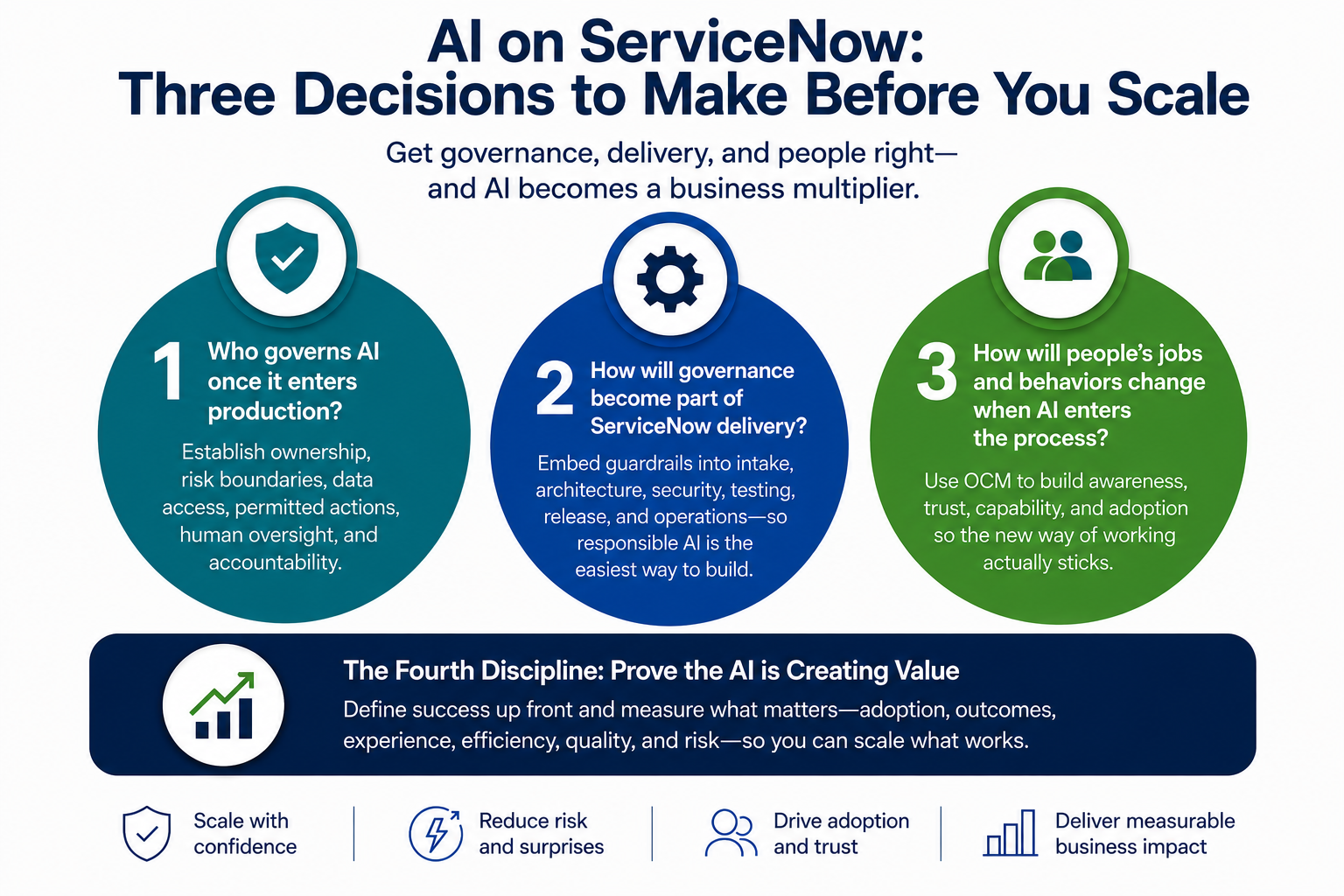
As AI moves from experimentation into production on the ServiceNow platform, the organizations that succeed will not necessarily be the ones that deploy the most AI capabilities first. They will be the ones that make three decisions early:
Who governs AI? How does governance become part of delivery? And how will people’s jobs and behaviors change once AI enters the process?
These are not simply technology questions. They are operating-model questions spanning governance, platform delivery, Organizational Change Management (OCM), and workforce readiness.
And they become much more important when AI moves from an interesting pilot to something the enterprise depends on.
Decision 1: Who governs AI once it enters production?
Many organizations still approach AI governance primarily as a policy exercise. Legal, compliance, security, or risk teams establish principles, define acceptable use, and document what the organization should or should not do.
That is necessary.
But governance becomes operational when AI begins interacting with enterprise data, generating content, recommending decisions, routing work, or taking actions on behalf of a user.
At that point, organizations need clear answers to practical questions:
- Who owns the AI use case?
- What data can it access?
- What actions is it permitted to take?
- Where is human approval required?
- What happens when it is wrong?
- Who monitors its behavior after go-live?
- Who has the authority to change or disable it?
These questions are particularly important on ServiceNow because AI does not operate in isolation. Now Assist, Virtual Agent, AI agents, workflows, knowledge, integrations, and enterprise data operate within a platform already connected to critical business processes.
ServiceNow’s own AI governance program offers a useful reference point. In The Four Essential Elements to Responsible AI Governance, ServiceNow describes a cross-functional Digital Technology AI Council, an AI System Development Lifecycle, and approximately 44 control objectives mapped across frameworks including the NIST AI Risk Management Framework, the EU AI Act, and ISO 42001.
The important point isn’t the number of controls.
It’s that governance is embedded into how AI is designed, reviewed, released, and operated — rather than added as a checkpoint after the technology has already been deployed.
ServiceNow customers do not necessarily need an equally complex structure. But before a Now Assist capability, AI agent, Virtual Agent experience, or AI-driven workflow reaches production, the organization should understand its ownership, risk, data boundaries, permitted actions, human-control points, and monitoring requirements.
The objective isn’t to slow AI down.
It is to create enough structure that the organization can scale it with confidence.
Decision 2: How will governance become part of ServiceNow delivery?
A company can have an excellent AI governance framework and still fail to govern AI effectively.
The breakdown usually happens between policy and delivery.
Governance may be defined by one group while implementation is performed by another. Under delivery pressure, controls that sit outside the normal development process can quickly become additional approvals teams learn to navigate around.
Enablement closes that gap.
For ServiceNow, that means translating AI governance into the actual mechanics of platform delivery: use-case intake, architecture, data access, security, knowledge quality, development, testing, release management, monitoring, and operational ownership.
An AI use case should not enter development without an owner and defined purpose. Data access should be understood before an agent or skill is activated. Existing ACLs, roles, knowledge, and source data should be evaluated in the context of how AI will use them. Testing should consider not only whether the functionality works, but also what happens when it behaves unexpectedly.
And someone needs to own the capability after the implementation team leaves.
These controls should not exist only in an AI governance document. They should appear in intake criteria, architecture reviews, user stories, acceptance criteria, testing, release gates, and operational monitoring.
That is the difference between having an AI governance framework and operating one.
It also recognizes something important about AI: production is not necessarily the finish line.
AI-driven capabilities require continued observation, evaluation, and adjustment. Organizations therefore need a lifecycle that extends from use-case identification through design, build, release, monitoring, optimization, and eventually retirement.
The goal is to make responsible AI delivery the normal way the platform operates — not an additional process teams have to work around.
Decision 3: How will people’s jobs and behaviors change when AI enters the process?
Governance and platform controls determine what AI is allowed to do.
They do not guarantee that anyone will use it.
This is where many AI programs underestimate Organizational Change Management.
AI literacy matters, but literacy alone does not create adoption. A service desk agent can understand Now Assist and still ignore its recommendations. An employee can have access to Virtual Agent and continue calling the service desk. A fulfiller can complete AI training and continue performing the same manual steps because the new process never became the easier or trusted way to work.
The better question is not:
“Have we trained people on AI?”
It is:
“What will people do differently because AI is now part of the process?”
That requires more than a generic AI training deck.
Employees need to understand what the AI is designed to do, what it is not allowed to do, when they can rely on its output, when human judgment takes precedence, how to correct or escalate an incorrect result, and how their own responsibilities are changing.
The enablement also needs to be role-specific.
A service desk agent working with AI-generated resolutions needs something different from an approver reviewing an AI-generated recommendation. A fulfiller working alongside Now Assist needs different guidance from the platform owner responsible for monitoring the capability after deployment.
That means OCM should become part of the implementation itself: identifying impacted roles, redesigning affected processes, creating role-specific enablement, communicating why the process is changing, building feedback loops, establishing adoption champions, and measuring whether people are actually using the capability as intended.
The implementation is not successful when the AI feature goes live. It is successful when the behavior around it changes.
One discipline connects all three: measure whether AI is creating value
Governance, enablement, and change management establish the conditions for AI to scale.
Measurement tells you whether it should.
Before deployment, organizations should define what success actually means for each use case.
Depending on the process, that may include reduced resolution time, increased self-service, improved deflection, lower case volume, reduced manual effort, fewer errors, faster fulfillment, or improved employee and customer experience.
AI-specific operational measures matter as well: adoption, exception rates, human intervention, escalations, incorrect responses, and the percentage of AI-generated recommendations that users accept or override.
This matters because AI adoption and AI value are not the same thing.
McKinsey’s State of AI research shows that AI experimentation is widespread while enterprise-level scaling and measurable financial impact remain significantly less common. One characteristic associated with organizations generating greater value from AI is workflow redesign — changing how work actually happens rather than simply inserting AI into an existing process.
That distinction should shape the ServiceNow AI roadmap.
The objective is not to deploy more AI.
The objective is to improve how the enterprise operates.
From AI pilot to AI operating model
The sequence matters.
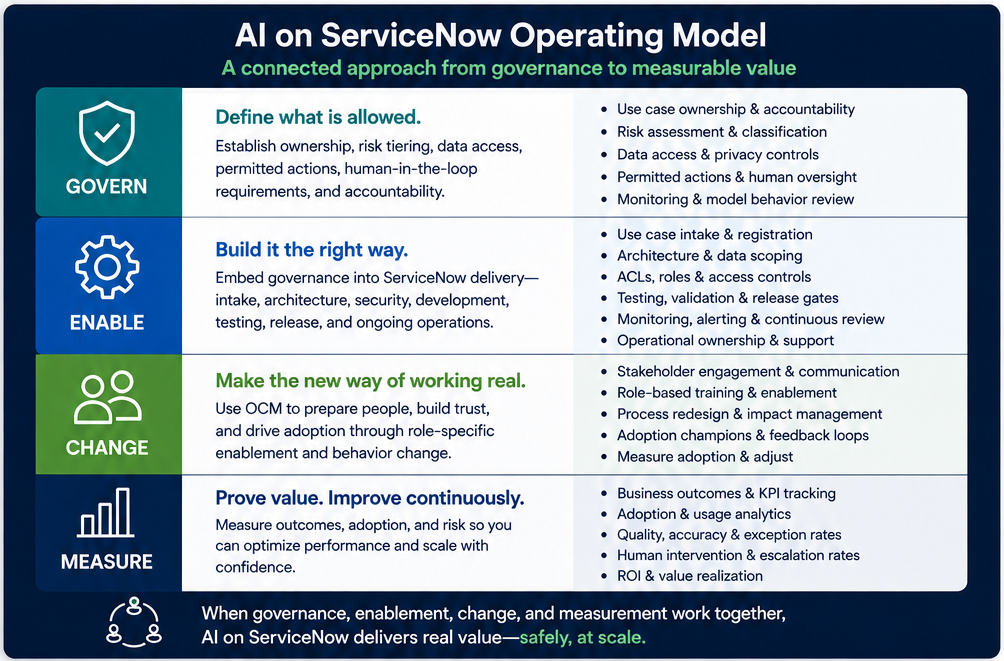
Governance defines what is allowed. Enablement turns those guardrails into how the platform is built and operated. Change management makes the new way of working real. Measurement determines whether it is creating value.
None of this is an argument for slowing down AI adoption.
It is an argument for moving quickly in the right sequence.
Organizations that establish these disciplines early can move faster later because governance, controls, ownership, adoption, and measurement do not need to be reinvented every time a new AI use case enters the roadmap.
Building the operating model around ServiceNow AI
Activating AI on ServiceNow is becoming easier. Building the governance, delivery controls, workforce adoption, and measurement model around it is where much of the real work begins.
WCC helps organizations establish that operating model so Now Assist, AI agents, Virtual Agent, and agentic workflows can move beyond experimentation and scale with appropriate governance, adoption, and measurable business outcomes.
If your organization is planning its next phase of AI on ServiceNow, we’re available to help you build the right foundation for what comes next.